Golden Tongues and Hundreds of Coffins
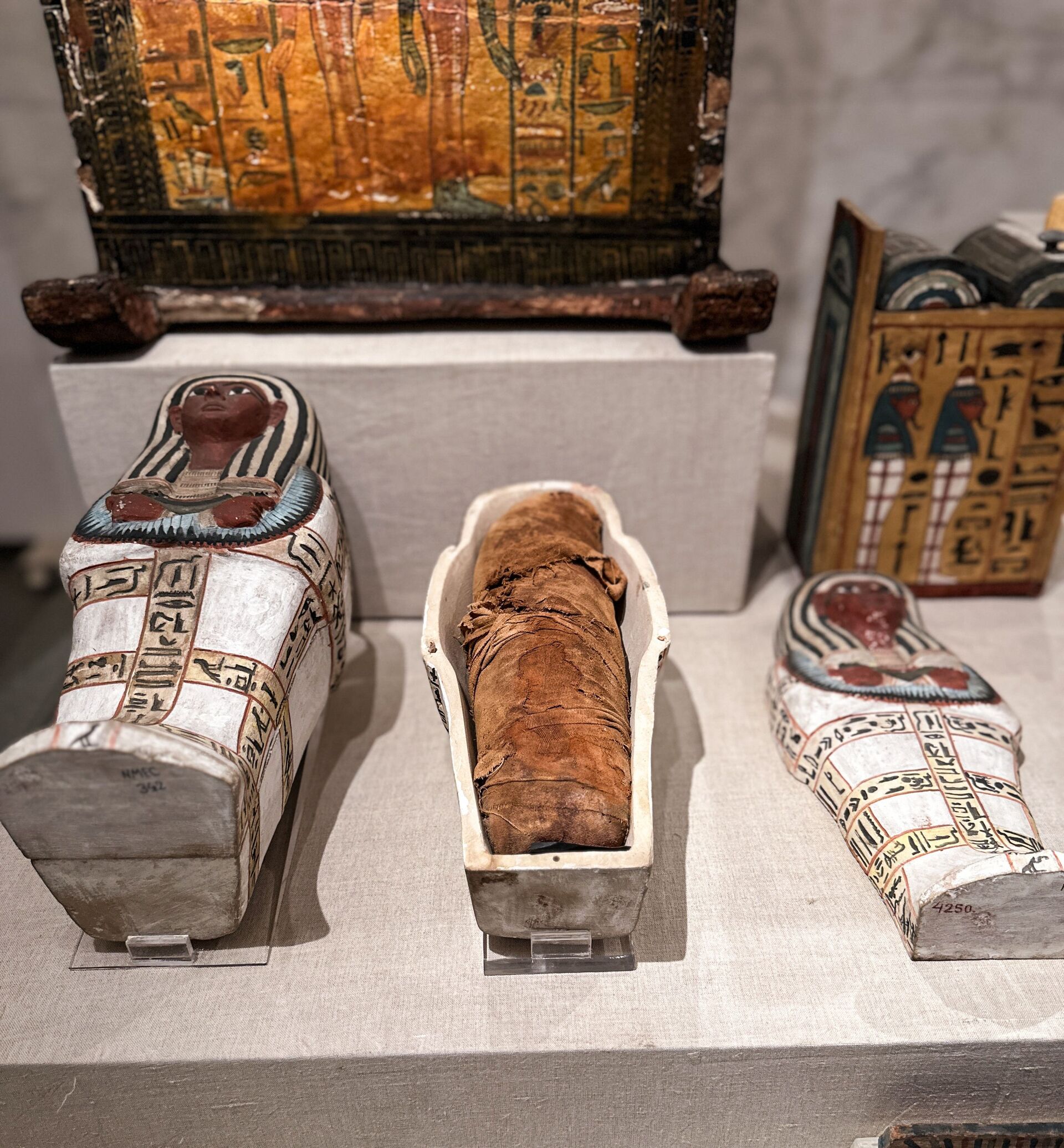
At the edge of the desert, where the green of the Nile Delta gives way to sand and the road runs west to the salt lakes of Wadi el-Natrun, Egyptian archaeologists have opened up a crowded city of the dead. Hundreds of stone coffins lie in an open courtyard, many smashed long ago. And among the bones, the excavators found small pieces of gold shaped like tongues, put into the mouths of the dead so they could speak in the next world.
Search our Network. Start here.
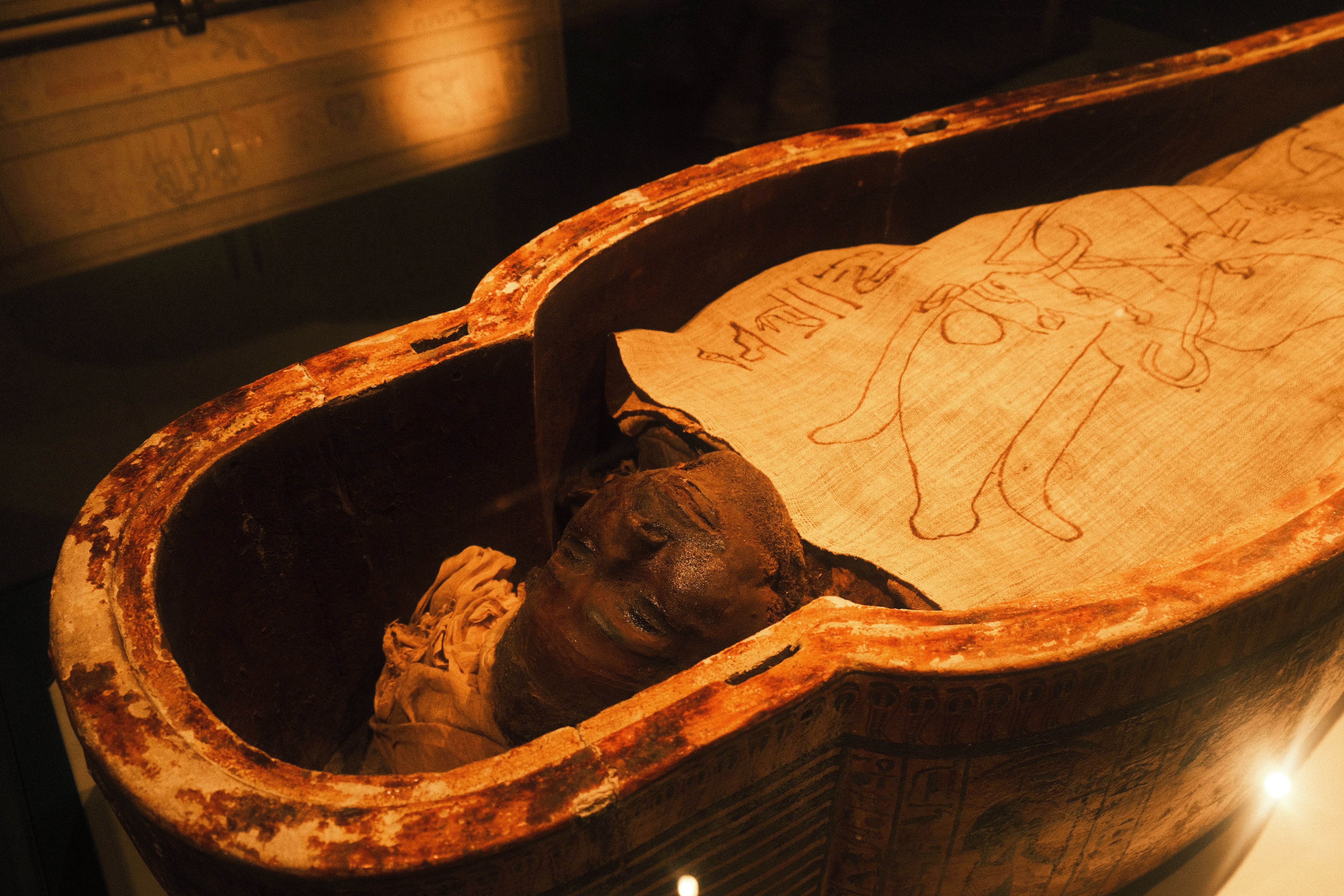
- Where: Tell Kom Abu Billo, Menoufia Governorate, on the western edge of the Nile Delta, inside the ruins of ancient Terenouthis (modern Tarrana). 📍 Map
- Announced: 18 November 2026 by Egypt's Ministry of Tourism and Antiquities
- Excavated by: an Egyptian mission of the Supreme Council of Antiquities
- Age: end of the Late Period to the early Roman period; most burials 3rd–2nd century BC (Ptolemaic)
- Found: hundreds of stone and pottery coffins, mudbrick tombs, golden tongues, jewellery, amulets, two falcon burials
- Can you visit? No. It is an active excavation in a protected archaeological zone
A forgotten city on the salt road
Terenouthis is not a name most visitors to Egypt have heard. In ancient times it mattered for one simple reason: location. The town sat at the eastern entrance to Wadi el-Natrun, the desert valley whose salt lakes produced natron, the mineral salt that embalmers used to dry out the bodies of the dead. The Greek historian Herodotus, who visited Egypt in the fifth century BC, described how the body was covered in natron for seventy days during mummification. Every mummy in Egypt needed it, and a good part of it passed this way.
The town's main goddess was Hathor. Earlier digs found remains of the city and of her temple, and the site is also linked to Renenutet, the snake goddess of the harvest, and to Osiris and Isis. Archaeologists have been coming here for well over a century: the Egypt Exploration Fund in 1888, the University of Michigan's Kelsey Museum in 1935, and Egypt's Antiquities Service in rescue excavations between 1969 and 1975, when the el-Nasseri canal was dug through the area. Since 2013 the French Institute of Oriental Archaeology (IFAO) has worked here too, mainly in a Roman-era necropolis.
What the excavators found
The new find is a burial ground of a kind not seen before at this site. Hisham El-Leithy, Secretary General of the Supreme Council of Antiquities, said it was the first time so many burials and coffins had been found together in an open courtyard here, and that more architecture still lies under the sand.
- Coffins: hundreds of stone coffins, many pottery coffins (some with roughly drawn human faces, others fully human-shaped) and the remains of wooden ones.
- Tombs: vaulted tombs built of mudbrick, and one tomb lined inside with limestone.
- The dead: poorly preserved remains, but with traces of embalming resins and pieces of painted cartonnage and plaster in yellow, red, blue and gold.
- Gold: golden tongues, an earring, a pendant from a gold necklace, thin gold sheets.
- Amulets and figures: scarabs (one in blue lapis), wedjat eyes, large numbers of faience ushabti figurines, offering tables, small sphinxes, fragments of statues of the falcon god Horus.
- Animals: two falcon burials lying between the coffins.
- One special piece: part of a fired clay lid showing Isis-Aphrodite seated on a lotus, nursing the child Harpocrates, a mix of Egyptian and Greek religion typical of Ptolemaic Egypt.
According to Mohamed Abdel-Badie, head of the Egyptian Antiquities Sector, the dating rests on the layers of earth, the pottery, the coffin styles, the burial customs and the tomb architecture.
Smashed coffins and lost lids
Not every grave survived the centuries. Mostafa Rizk, Director General of Menoufia Antiquities, described a surface layer of hundreds of stone coffins, some without lids and others broken apart. The ministry blames earlier vandalism and quarrying, and press reports also mention looting. Stone was valuable, and ancient cemeteries close to farmland were robbed and dug over for building material long before archaeologists arrived. That some burials still held gold is the surprise.
Why put a golden tongue in a dead man's mouth?
Golden tongues are small sheets of gold foil cut in the shape of a tongue and placed in the mouth of the dead. The idea, as Egyptian archaeologists have explained in earlier finds, was to give the dead the power of speech in the afterlife, so they could speak before Osiris, the judge of the dead. Gold mattered too: Egyptians believed it was the flesh of the gods, eternal and incorruptible.
The custom belongs mostly to the Greek and Roman centuries of Egyptian history. That fits Terenouthis exactly. One honest note: the ministry's statement lists golden tongues among the finds but does not say how many, so any number you read elsewhere is a guess.
A cemetery for ordinary people
This was probably not a burial place for kings or high priests. A first study of the grave goods suggests the cemetery mainly served the middle class: traders, officials and craftspeople of a busy town on the salt road. That is what makes it valuable. Royal tombs tell us how the powerful wished to be remembered; cemeteries like this one tell us how ordinary families faced death, and how much they were prepared to spend so their loved ones could speak again on the other side.
2026: the year of golden tongues
If you heard about an "ancient city found in the desert", you may have heard about more than one discovery. 2026 has been an extraordinary year:
- April: a Spanish mission at el-Bahnasa (ancient Oxyrhynchus) in Minya reported a rare Roman-period tomb with mummies carrying tongues of gold and copper. 📍 Show on map
- July: at Marina el-Alamein on the Mediterranean coast, ancient Leukaspis, archaeologists opened 18 more tombs, some still sealed with their original stone slabs, and found 24 gold tongues in the mouths of the dead. 📍 Show on map (approximate)
- July: in the Dakhla Oasis of the Western Desert, a well-preserved fourth-century Byzantine town with streets and a church was announced. 📍 Show the oasis on map (exact site not published)
- November: Terenouthis, with hundreds of coffins in a single open courtyard. 📍 See the map below
Egypt announces discoveries steadily, and tourism is part of the reason: every new find is also an advertisement. That doesn't make the finds less real. But it is worth reading the original statements rather than the most excited headlines, which is why we link to them below.
Where it is
Tell Kom Abu Billo, ancient Terenouthis, lies just west of the town of Tarrana in Menoufia, between the green farmland of the Nile Delta and the desert road to Wadi el-Natrun. The marker shows the site.
Open the larger map · Coordinates 30.4324° N, 30.8158° E, from the Pleiades gazetteer of ancient places · Map © OpenStreetMap contributors
Can you visit?
Not yet. Tell Kom Abu Billo is a protected archaeological zone with excavations still running, and the finds will go into storage and study first. If you are travelling the desert road between Cairo and Alexandria, the area around Wadi el-Natrun is known for its old Coptic monasteries, some of which welcome respectful visitors. To see golden tongues and mummies today, the museums of Cairo are your best start.
Tours from Cairo
Pyramids, museums and day trips. Entrance fees are included in the tour price; tips are not included but are always welcome.
Sources
First-hand and official
- Ministry of Tourism and Antiquities statement, 18 Nov 2026, via Egypt's National Media Authority (Arabic)
- Egypt's Ministry of Tourism and Antiquities (official website)
- Masrawy: the ministry's announcement in full (Arabic)
- French Institute of Oriental Archaeology (IFAO): the Kôm Abou Billou mission
- Herodotus, Histories, Book 2, chapter 86: on embalming with natron
- Pleiades gazetteer: Terenouthis (location)
Press reports
More from Egypt: Egypt heritage blog · Egypt home
Across Africa: African Independence · Ethiopia · Morocco · All African Radio Stations
Updated and fact-checked: 21 November 2026. Excavations at Tell Kom Abu Billo are continuing; we will update this post when the ministry publishes more.